



Those who attended July’s celebrati on weekend at Mirfield – and, indeed, those who have read the new Church of the Resurrection book – will be aware that the one major commission outstanding for the Community Church is a new High Altar. The process of identifying the stone and the craftsman to work it has been protracted, as we wanted to ensure the design and materials are ‘right’, and there were a number of hiccups along the way.
We have agreed that the altar should be made of Mandale fossil limestone, quarried in the Peak District, and James Elliott – whose recent commissions include the tomb of Richard III in Leicester Cathedral – has been appointed to undertake the work.
The stone is medium grey, perhaps leaning towards light brown, in colour, and the ivory coloured fossils it contains were laid down in the sedimentary bedrock during the carboniferous period – around 365 million years ago. The fossils are mainly crinoids, brachiopods, corals and even occasionally shark’s teeth! In tune with the whole artistic scheme of the church, and the Stations of Salvation, we wanted an altar that would speak to people of the immensity of the ages, and that ‘a thousand years in your sight are but as yesterday’.
There is, inevitably, a cost to finishing and installing the Altar in time for the celebration of the 80th anniversary of the completion of the Community Church in July 2018. We have already received generous support, meaning that we need to find another £10,000 to pay for works in full. If you would be interested in supporting this work, and making a lasting contribution to a focal point of the worship of the Community and our guests, please do be in touch.
George CR


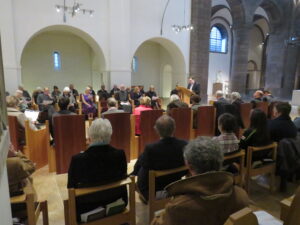 On Sunday afternoon, 22nd January, the Community of the Resurrection hosted the Churches Together in Mirfield and District and their annual Unity Service. This year’s liturgy was written by the churches of Germany, and its theme entitled “Crossing Barriers” reflected their experiences of life in a country that was divided by the Iron Curtain during the Cold War.
 On 25 – 26 January I travelled with Fr Thomas, and my Parish Priest to a ‘Growing Vocations Conference’ organised by Ministry Division, held at King’s Park Conference Centre. The opportunity came through Dr Peta Dunstan talking with Ministry Division, and I was asked to speak about the Religious Life on a discussion panel ably chaired by Bishop Libby Lane. Also joining in the discussion were representatives of Readers and the Church Missionary Society (CMS).
 January 14th 2017 saw the launch of St Hild College, formed by the merger of St Barnabas Theological Centre and the Yorkshire Ministry Course, which has been based at Mirfield since 2007. St Hild will train Anglican ordinands, Baptist ministers in training and independent students through teaching centres in Mirfield, Sheffield and York. The partnership with Mirfield will continue, with the St Hild College office continuing to be based at the site.
 The community has been fortunate of late to enjoy visits from other communities. The latest of these has been by the Archbishop’s Community of St. Anselm based at Lambeth Palace. Last week we hosted Miranda and Michael, Methodist North American citizens from Florida and Mississippi.
 The Mirfield Centre hosted a fully-booked residential conference on Anglican Social Theology from 20th to 21st January. Participants came from across the country including Truro, London, Gloucester and Durham. The speakers told the story of this movement from its Nineteenth century roots in the thought and action of F.D Maurice and the Christian Socialists, through Brooke Foss Westcott and Mirfield’s own Charles Gore, to William Temple and his successors.


